The Unhandy Valley
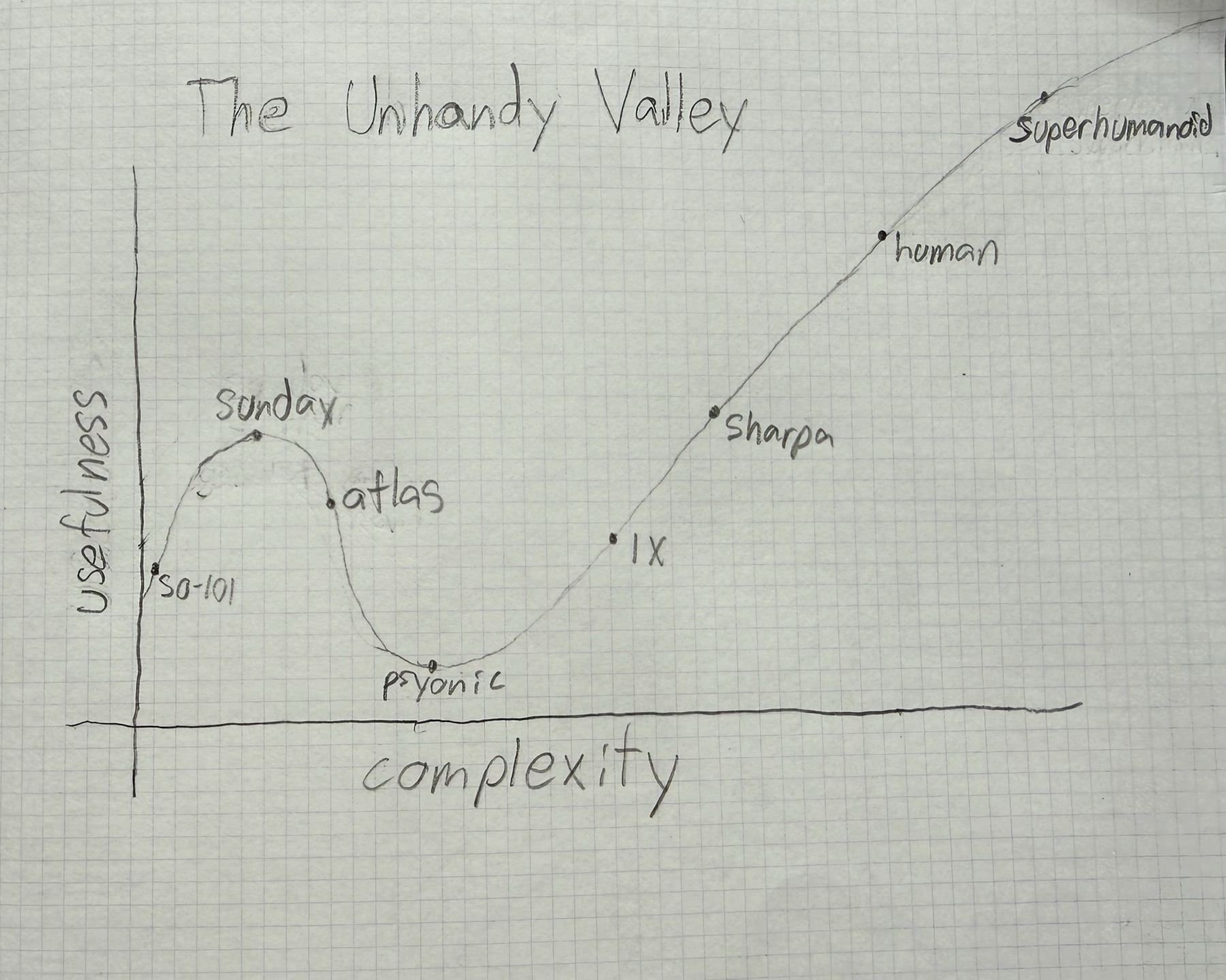
hello The robotics end effector has evolved into many form factors. From the simplest grippers to full-on humanoid hands, there’s an entire spectrum of these end effectors. And it’s been very interesting to see how the industry’s been moving forward with this, and especially interesting to see two areas of this graph. Area one is the local maximum around the early in the curve where things are still very simple. This is like usually two or three fingered grippers. And then past that, everyone thinks that they’re trying to make the human hand. So they shoot for the human hand, and they don’t succeed. They don’t get there. Some get further than others. There’s multiple parts in this valley that companies and research has fallen into. But what is true is that they have fallen into this. As this research progresses, I can foresee, I can foresee humanoid hands kind of starting to crawl out of the valley. But as they crawl out, there will be, there’s likely more complexity to hit closer to human level.
Oh, okay. Spider graph for the human hand. Something I want to show the human hand, it doesn’t have a set spider graph. Like, I want it to kind of morph into like, oh, the average hand, and then pull some data off of what the average hand can do. And then go into, like, okay, like I think an extreme example is like someone who’s a climber. Someone who’s a climber, they probably have like not the best like sensitivity on their hands. They probably like got so many calluses, but their strength is unmatched. And then maybe someone else, someone like does like microscopic hair work, and they’ve kind of just trained their hands to do this. So their like fine manipulation is really high. They’re like tactile is just like, we kind of evolve, like we grow with our hands. So like with anything with the human body, as we use it more, you build more muscles, you build more intuition. Like it’s this like coupled system, and that’s what makes humans so incredible, is how we grow with our bodies and with our minds. It’s not like we just like have these stats preformed. And that’s kind of what’s happening with robotics, is we put stats on these robots. And it’s not like this hand can now just magically get stronger by working out. I got kind of derailed there.
And another thought on that is it’s like, even if humanoid hands get there, they’re not what changes the world. What changes the world are the simple, simple, like just grippers and modular end effectors. Like, simplicity is king. Like, I’m trying to predict who the Toyota of robotics is gonna be. What’s gonna be that form factor of a robot that ends up producing millions of goods in factory, in autonomous factories? And I do foresee that like, there probably are like humanoids in these autonomous factories. But that’s not what does the work. Maybe the humanoids are there to kind of pair things and move things around.
Oh, funny enough, the whole tool use thing is part of the argument for keeping our hands, where they’re saying that, like, oh, I want the hand to be able to go and use my drill, to go use my uh my vacuum, because you, like, need, like, you need multiple fingers for that to do that whole because these objects are meant for us to use. The thing with the grippers, that’s interesting as well, like the simple gripper, like, I think that the winning core factor in terms of what changes the world is a…
It’s a simple gripper that is also interchangeable. Like, you can, like, it’s like a station that’s doing assembly of whatever. It’s like a mix of grippers, and then, like, oh, like this station needs a, like, needs to be able to screw things in. Okay, what if we just have a screwdriver end effector, like an electric one? Like, that’s just always gonna be better than, like, a gripper trying to pick up a screwdriver and use it. Like, that’s just like, it’s so, so much complexity for zero gain. Like, someone’s gonna eventually come out with a simple arm that’s hopefully also very modular. Like, you just change out the end effector.
Okay, another concept to explore here, and this is something that will come later in the essay because the focus is on the purely end effector to begin, but it’s like the end effector is part of a bigger system. And two things I want to focus on in this bigger system, number one is the actual arm that it’s attached to. Like, how precise is it? How repeatable is it? How reliable is it? How fast is it? There’s a lot. It’s like, the systems are intertwined. If you have a shit arm that’s just not precise, then you just won’t be able to do fine manipulation with it.
The second thing that goes hand in hand is, like, I’m kind of thinking of these, like, autonomous factories, but even, like, before they hit that stage, like, the surrounding systems around it, the conveyor belts, the cameras, the automation systems, the, like, uh, their… It’s like, an arm is only as good as the surrounding environment. If you go for something like a table mount and foot mount, like, this is a lot of the argument people say humanoids in factories, I think it’s fucking stupid. I think it’s stupid.
Like, maybe you have something there to repair when the arms break and things around, but they’re not what actually does labor. Like, whenever I see, like, videos of, like, a humanoid, like, doing pick-and-place tasks in an automotive factory, I, like, actually, like, I’m like, what the fuck?